Showing posts with label pedagogy. Show all posts

Introduction to Backwards Course Design

If you'll be designing a new course this semester, or revamping an existing one, what method will you use to do this? Most instructors begin by choosing a list of topics they want to teach, then perhaps a textbook, before moving on to writing the lectures, and finally creating assignments.  One problem with this approach is that you lose the ability to know if you've accomplished your goal of teaching the students what you want them to learn.  Knowing that they’ve learned the material requires evidence, and in this case the evidence has to be something that the students do.  So a better solution would be to consider what the students will learn to do (e.g., “calculate the area of a rectangle”) rather than a topic (“area”).  If they are able to do what you want to teach them, then you know you succeeded.


This is where backwards course design starts:  express what you want your students to learn to do: calculate the area of a rectangle, explain the difference between two theories, design a certain piece of technology, perform a procedure successfully, etc.
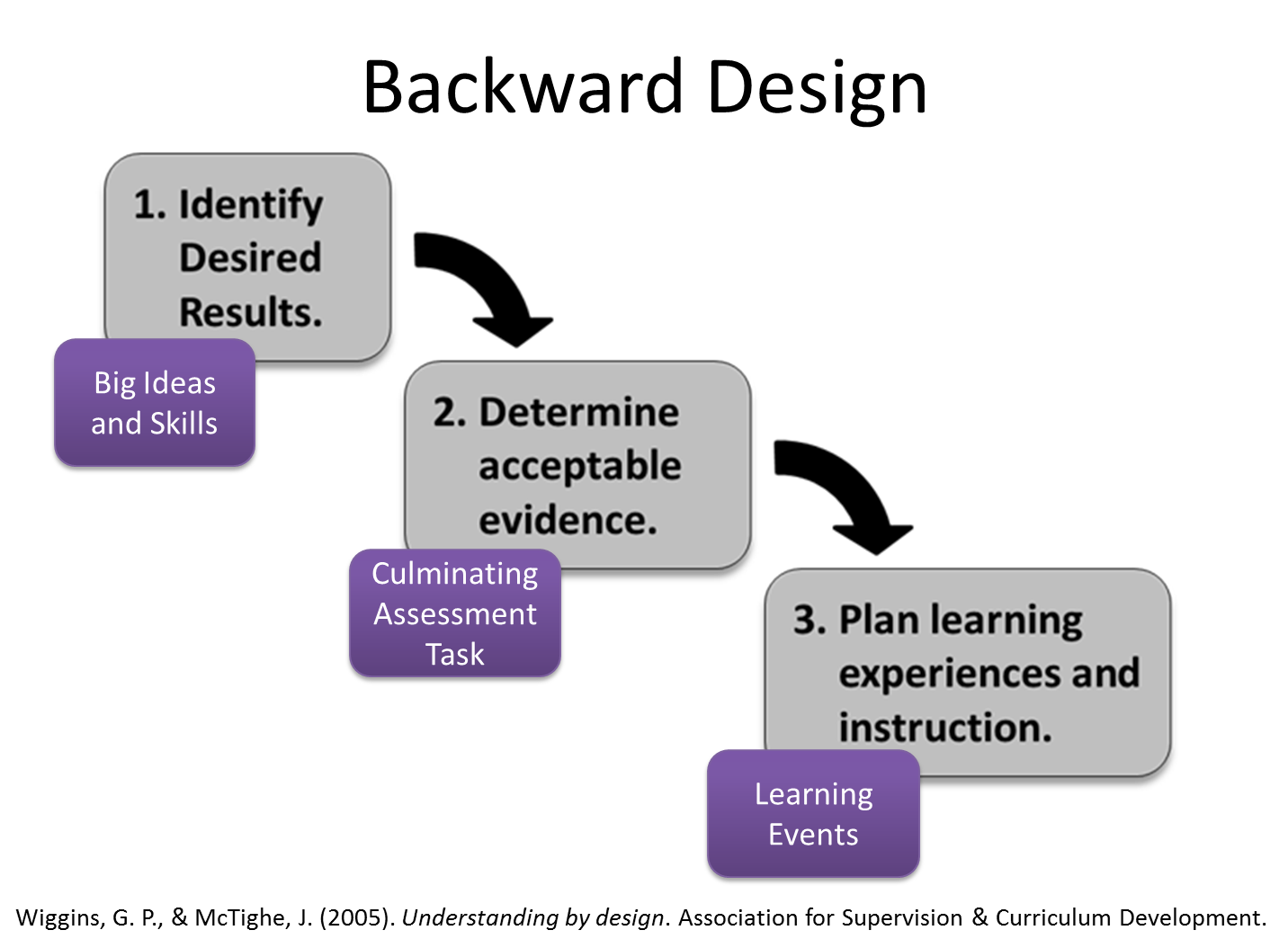


Next, consider what you would accept as evidence for their being able to do a learning goal you described in the first step:  must they simply answer a quiz question about the area of a rectangle?  Or are you more ambitious:  should they take pictures of ten rectangles and calculate their areas?  Create a presentation in which they explain the difference between two theories to someone outside the class?  Create a schematic diagram working in groups?  Keep a notebook documenting a procedure with explanations of each step?


Finally, consider what you need to do to prepare them to provide that evidence.  Don’t just plan to lecture on the area of rectangles – plan to lecture on how rectangles are used in building and manufacturing, and why it’s important to know their areas.  Don’t just suggest two videos on two different theories – also recommend a video on how to create explanatory presentations.  Lecture on how to break down a project into smaller parts, so that each member of a group can make a meaningful contribution.  Assign an article about cases in which accurate notebooks saved an experiment.

This is backwards design in a nutshell: first express what you want your students to learn in terms of what they will be able to do after learning the material, then decide what will count as evidence, and then choose learning experiences that will prepare them to produce that evidence. You'll express more clearly what you want your students to learn, will have evidence of success, and will make your course more student-focused also!

For more information on backwards course design, read the first chapter of Understanding by Design (Wiggins & McTighe, 1998).

Tips for Facilitating Online Discussions as an Extension of the Traditional Classroom

If you teach in a traditional setting, you might not be familiar with or see the need for online discussions, but there are several reasons why an online discussion can be a valuable tool, even for classes that regularly have traditional discussions:
  • Online discussions give every student a chance to contribute to the conversation. 
  • For a variety of reasons, some students don't feel comfortable participating in in-class discussions, but those same students may feel right at home in the online setting. 
  • Online discussions give students the time to thoughtfully compose each response without feeling like they are "on the spot".
  • Students are given the opportunity to practice online writing skills and learn how to handle online conflict in a respectful way.
  • Sometimes there just isn't the time for an in-depth discussion in class.  A discussion that starts in class can continue online.
If you decide to give online discussions a try, be sure to consider these tips.

Tips for writing effective discussion questions
Do:
  • Activate prior knowledge and experience
  • Ask students to explain their answers
  • Prepare and ask follow-up questions
  • Ask questions that create controversy or will demonstrate a wide variety of opinions
  • Provide suggestions for what students should focus on when responding to others
  • Utilize videos and other resources to help engage students in discussion

Don’t:
  • Ask questions that are strictly factual
  • Ask questions that can be answered with yes or no
  • Ask questions which have only one right/desired answer
Tips for facilitating a successful online discussion
Do:
  • Get involved
  • Monitor discussions regularly
  • Set clear and rigorous expectations for language, grammar, posting lengths and number of posts
  • Do make it clear to students how they will be assessed and graded
  • Ask follow-up questions to give the discussion new life
  • Provide timely feedback
Student tips for participating in online discussions
Do:
  • Explain why you agree or disagree, and add some examples to support your belief
  • Relate your personal or work experiences to the topic at hand
  • Ask additional questions of your classmates
  • Make connections between the topics at hand and the readings in the text or related articles
  • Add ways you can apply the lessons from the class in your work and educational life